
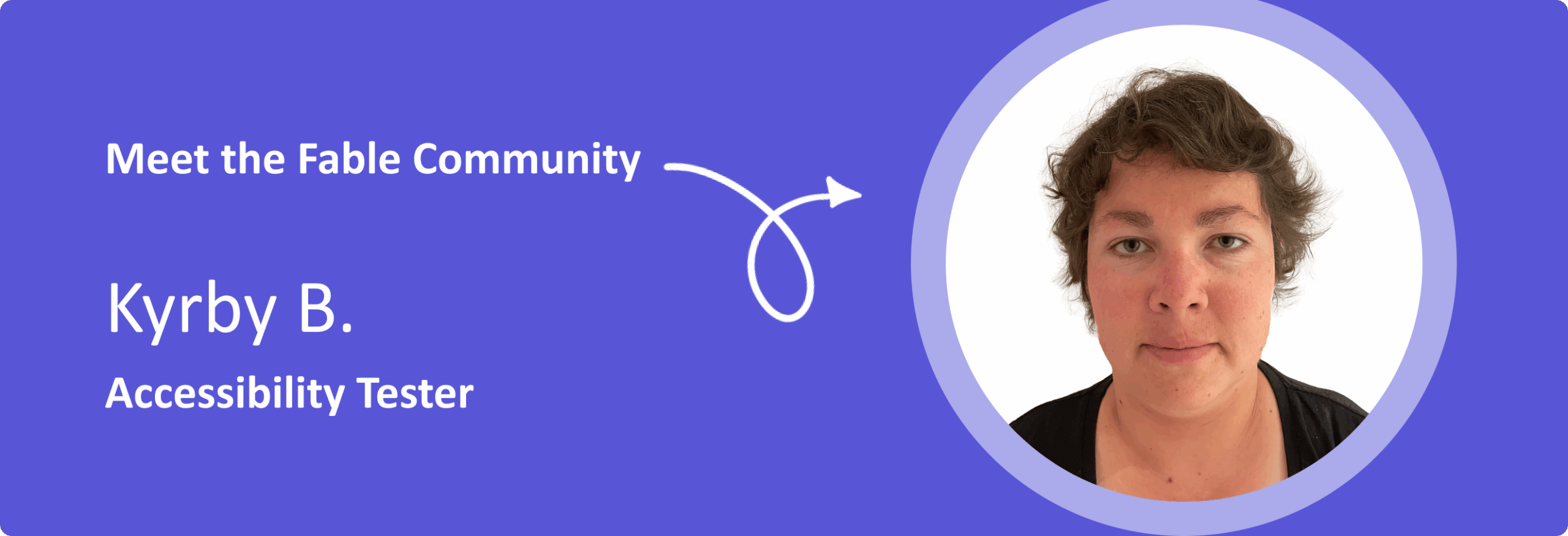

Meet the Fable Community: Kyrby B.
- Pronouns: She/her
- Time zone: GMT
- Languages spoken: English
Kyrby is in her twenties and has Quadriplegic Arthrogryposis, a condition that affects all four limbs and causes joint contractures, muscle weakness, and limited range of movement. She primarily uses Apple Voice Control to navigate digital experiences, and also uses Windows Voice Access with Microsoft products.
Kyrby’s background and interests
Kyrby is a former member of the Para Dressage Squad for Team Great Britain. She rode competitively up until COVID hit. During that time Kyrby also started using a running frame to stay physically and mentally healthy. That routine segued into a business development role for the company that distributed the frames in the UK.
Today, Kyrby continues to distribute running frames through her own adaptive recreation business called Momentum Mobility & Rehab. She also manages a team conducting access audits for companies.
“Everything we do is guided by lived experience,” she says. “It’s not about ticking boxes or signing off from a building standards point of view. It’s more that we look at the issues and then offer solutions that will work for as many people as possible.”
Kyrby’s assistive technology and adaptations
Kyrby prefers to use her iPad or iPhone to navigate most digital experiences. She is transitioning away from relying on physical movements, like typing, and toward greater use of assistive technology.
“I’m still capable of some physical movement, but I want to maintain what I have,” she says. “I’m losing a lot of movement in my shoulders and typing triggers a lot of muscle spasm tension. I went from not wanting to use an iPad to preferring it because the Voice Control is more intuitive.”
Kyrby’s top accessibility pain points
It’s common for drop-down menus to present issues, where the links behind overlay what she wants to see. And sometimes the drop-downs won’t appear at all. However, one of Kyrby’s biggest pet peeves is how different websites scroll at different rates when she’s using Voice Control.
“One of the hardest parts of using Voice Control is smoothly scrolling down a screen whilst reading all the information,” she says. “I’m constantly having to say the same words on repeat. Or I’ll say ‘scroll down’ and it takes me right to the bottom of the screen so I miss things.”
What Kyrby wishes more design and product teams knew about digital accessibility
In the UK, the Purple Pound refers to the spending power of disabled households. Kyrby says when companies release products with accessibility barriers, they effectively isolate a huge percentage of potential users.
“Disabled people make up roughly 15% of the world population, and in the UK they make up about 85%,” she says. “That’s a massive group of people with a broad range of impairments. We have money that we want to spend with you and the better you design products, the more likely we will be to use them.”
Why Kyrby chose to work with Fable
Fable came across Kyrby’s radar through Patchwork Hub, a disabled-led employment platform and inclusive jobs board in the UK. She immediately connected with Fable’s ethos of compensating people with disabilities for sharing their lived experiences. She also loves the opportunity to give honest feedback and collaborate with companies to make products more usable for all.
“As disabled people, we have the responsibility to advocate for ourselves rather than shrink back,” she says. “The issue is not you or your assistive technology. The issue is that perhaps the organization isn’t aware or hasn’t fully considered accessibility. If we take that as a personal responsibility, it’s effectively an educational opportunity.”
