

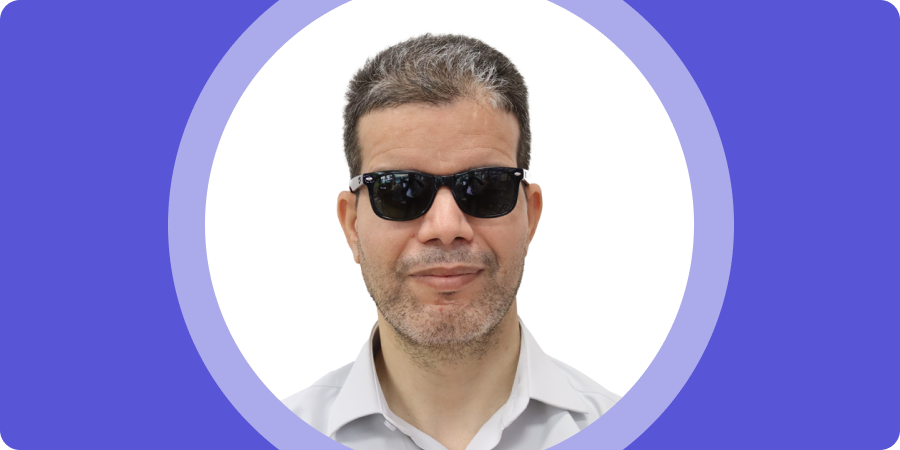
Meet the Fable Community: Hamid Aitouznag
- Pronouns: He/him
- Time zone: GMT
- Languages spoken: English, Amazighi, Arabic, and French
Hamid is in his forties, is blind, and also uses a wheelchair. Hamid uses screen reader technology to navigate digital experiences. He primarily uses the JAWS screen reader on desktop (he even taught himself to rewrite code to improve how JAWS functions on certain websites!) but he’s also fluent in NVDA. On mobile he uses TalkBack for Android.
Hamid’s background and interests
Born in Morocco, Hamid recently relocated to the UK after a 16-year career as a legal advisor in the Moroccan court system. He holds a master’s degree in penal law and enjoys spending time in nature and listening thrillers and non-fiction stories on audiobook.
“I really like focusing on details,” says Hamid. “That helped a lot when I was a legal advisor. Many stakeholders kept coming back to me because they said I’m a good listener.”
Hamid’s assistive technology and adaptations
Hamid primarily uses the JAWS screen reader. He’s also fluent in NVDA (Nonvisual Desktop Access), which he learned to use through volunteer work in Morocco helping blind people get started with screen readers. He even taught himself to rewrite code to improve how JAWS functions on certain websites. On his smartphone, he uses TalkBack for Android.
“Some programs, applications and websites aren’t fully compatible with JAWS,” he explains. “I can program JAWS to retrieve information that I can’t access. That’s the difference between accessibility and usability. Accessibility may give you access, but sometimes it takes a lot of extra time and that’s not productive.”
Hamid’s top accessibility pain points
Hamid frequently experiences frustration with inaccessible websites and applications. He was forced to switch banks in Morocco because his bank’s website had many accessibility issues.
“Some of my sighted friends would recommend apps. I would download them and realize they’re completely unusable for me,” he says. “Once I find an experience that’s ‘good enough’ I tend to stick with it because trying new ones leads to more frustration.”
What Hamid wishes design and product teams knew about digital accessibility
Hamid wants to be able to use digital products just like any other sighted person. He says the answer lies in accessibility by design.
“When anyone designs a product, be it digital or physical, they should remember that nearly a quarter of the population has some kind of disability,” he says. “Regardless of my disabilities, I should be able to use products without any restrictions.”
Why Hamid chose to work with Fable
Hamid is now exploring a career change that will allow him tap into his passion for digital accessibility. He was introduced to Fable while studying WCAG and doing some user testing work. “I knew being part of the Fable community was perfect for me,” he says. “Being able to make my passion part of my work is the best.”
