
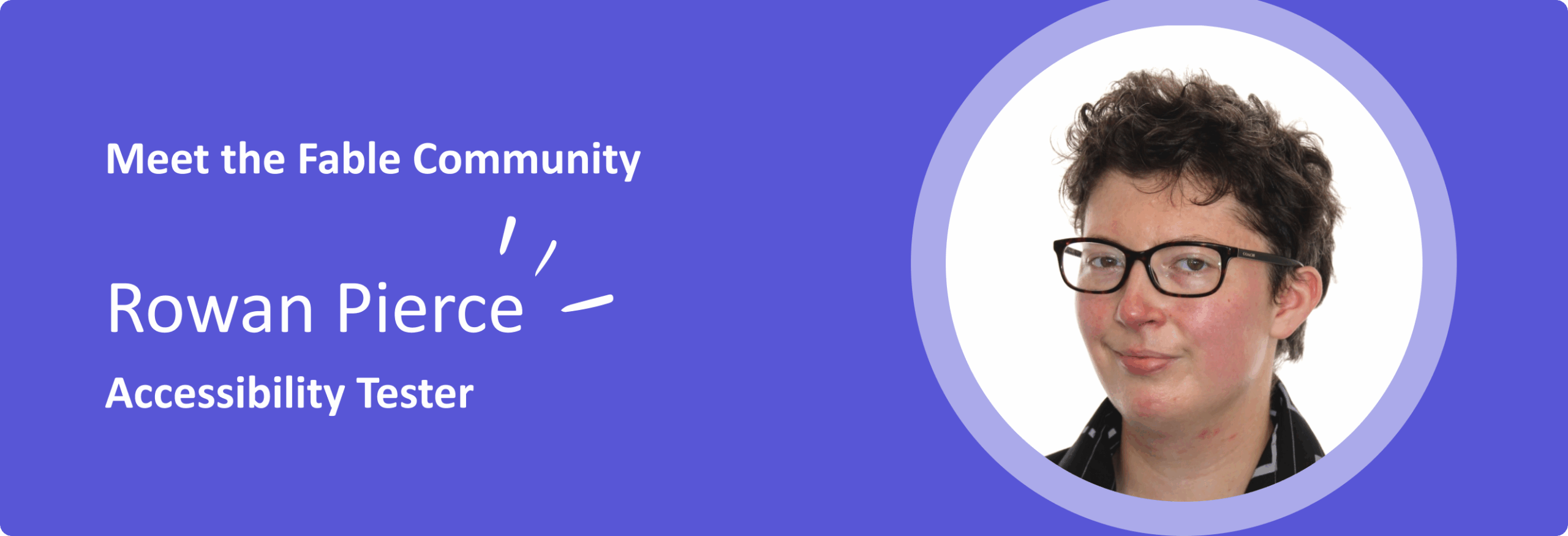
Meet the Fable Community: Rowan Pierce
- Pronouns: They/them
- Time zone: GMT
- Languages spoken: English
Rowan is in their thirties, is autistic and lives with Sjögren’s Syndrome as well as nerve damage from Guillain-Barré Syndrome. They use screen magnification (scaling settings on desktop set to 125% and font size increased on mobile), a blue light filter, dark mode, Dragon Home for dictation on desktop and Android’s built-in voice control and dictation on mobile.
Rowan’s background and interests
Rowan is a freelance editor and sensitivity reader with experience working on projects spanning novels and tabletop games to marketing materials and academic journals. They also have experience with both instructional design and graphic design. “My role has long involved making sure content is clear and engaging and delivered in a way that’s easy to digest,” says Rowan.
Rowan’s assistive technology and adaptations
Rowan describes their assistive tech journey as an ongoing process, adding tools as they’ve had the energy to learn them.
“Guillain-Barré Syndrome came on suddenly causing a dramatic loss of function in my limbs, face, and everywhere really,” says Rowan. “It’s taken years to develop strategies to manage my symptoms and learn which technologies are helpful and how to use them.”
Rowan’s top accessibility pain points
Rowan’s fatigue can be debilitating, making digital experiences that require a lot of scrolling or workarounds a huge barrier to usability.
“People intuitively understand that chronic fatigue makes walking to the shops and back difficult. But typing or scrolling can be just as tiring, especially if you’re doing it over and over again,” says Rowan. “On bad days, an online task that requires more mouse clicks or scrolls can mean choosing between ordering groceries or taking a shower. It’s that level of trade off.”
What Rowan wishes more design and product teams knew about digital accessibility
Rowan says it’s often obvious when a website hasn’t been tested at higher magnification. For example, paragraphs will overlap making the text unreadable. Or mobile pop-ups force them to go into phone settings and change magnification settings so they can close the pop-up.
“It makes a huge difference to have links at the top of the page that I can use to skip around and quickly get to what I need,” says Rowan. “Or to have the content all on one screen so I can see everything.”
Why Rowan chose to work with Fable
Rowan’s passion for accessibility, combined with lived experience, drew them to work with Fable. “It’s rewarding to give usability feedback and know I’m helping make services easier for disabled people to use. I also admire Fable’s commitment to diversity. They explicitly shout out the fact that they have trans and non-binary testers, and that’s wonderful to see.”
